

Is a cord cutting ritual safe to do at home?
A cord cutting ritual at home is safest when you treat it as a symbolic exercise and leave out flames, smoke, sharp tools and anything tied around your body. It cannot guarantee emotional closure or change another person’s behaviour, and you should stop if it increases fear, distress or the urge to contact someone who is unsafe for you.
- Is a cord cutting ritual safe? Choose a flame-free symbolic exercise, not burning cord between candles.
- Elisabeths Room offers practitioner-led spiritual services; these are not substitutes for mental health care or practical safety measures.
- Cord cutting does not establish another person’s feelings or guarantee that emotional attachment will disappear.
- Stop if the ritual increases distress; use real-world boundaries and appropriate support instead.
Is a cord cutting ritual safe to do at home?
A flame-free cord cutting ritual avoids the fire hazards of burning string, candles or personal objects. That does not make every ritual emotionally suitable. Your current state of mind and the meaning you attach to the exercise matter as much as the materials.
If you are considering the spiritual services offered by Elisabeths Room, distinguish a practitioner-led service from an activity you plan to perform yourself. Neither a service description nor an online demonstration establishes that a particular burning setup is safe to reproduce at home.
| Approach | Best for | Practical advantage | Limitation or risk |
|---|---|---|---|
| Written reflection | Naming a boundary privately | Needs no flame, smoke or cutting tool | Writing about a painful relationship can bring up distress |
| Gentle visualisation | A symbolic exercise without objects | Avoids physical ritual hazards | Mental imagery can feel unsettling; stop if it does |
| Candle-and-cord burning | Not recommended for a home release exercise | Provides a visible symbolic ending | Introduces flame, hot wax and unpredictable burning material |
| Practitioner-led spiritual service | People who prefer not to perform a ritual themselves | Removes the need to recreate a ritual at home | Does not guarantee closure or replace practical support |
For a home ritual in 2026, choose the method with the fewest physical hazards. A dramatic flame is not evidence that an emotional bond has ended.
Why this matters
A release ritual can become a decision point: you choose what you will stop doing, what boundary you will keep and who you will ask for support. The risk starts when the ritual becomes a test you believe you must pass before you are allowed to move on.
You do not need a particular candle pattern, a completely calm reaction or another person’s agreement to set a boundary. Your right to end contact does not depend on a ritual working.
There is also a difference between feeling emotionally attached and being physically unsafe. Harassment, coercion, stalking and threats call for practical protection, not interpretation of wax, smoke or dreams. Spiritual practices belong alongside real-world decisions, never in place of them.
How do you make a cord cutting ritual safer at home?
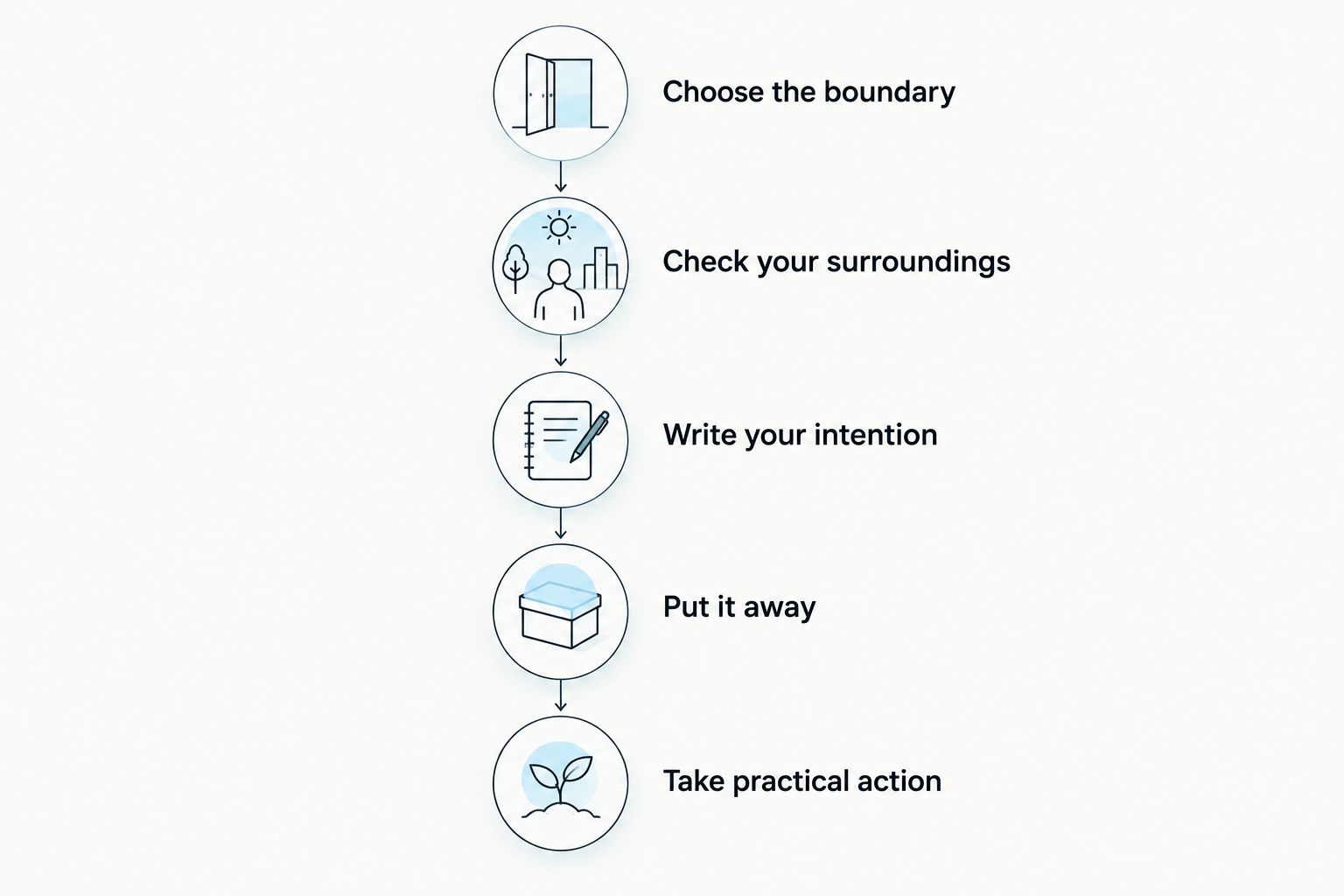
Use a written exercise rather than a burning setup. This approach keeps the focus on your choices without introducing fire or asking you to interpret a supposed sign.
- Choose the boundary. Write a specific action you control, such as not checking an ex-partner’s social media. Avoid goals that depend on changing someone else’s feelings.
- Check your surroundings. Choose a private, comfortable place where you can stop easily. Leave candles, incense, knives and physical cords out of the exercise.
- Write your intention. Describe what you want to release and what you want to protect. Keep it about your behaviour, attention and wellbeing rather than punishment or control.
- Put it away. Fold the paper and set it aside, or discard it without burning it. You do not need to destroy anything to mark an ending.
- Take practical action. Follow through on the boundary you named. If contact is necessary, decide how you will handle it rather than promising yourself that all contact must disappear.
The sequence is deliberately ordinary. You can use it as a reflection exercise without deciding that an invisible connection has been severed.
In 2026, apply the same safety standard to a ritual found on social media as you would to any unfamiliar activity involving fire. An attractive video is not a safety assessment, and editing can hide what happens before or after the clip.
Keep the intention within your control
A useful intention describes your next action: leaving an upsetting conversation, keeping communication practical or putting away reminders you no longer want to see. It does not promise that another person will forget you, apologise or stop contacting you.
If you share children, housing, work or other responsibilities, complete separation might not be practical. A boundary can instead concern the channel, subject or circumstances of necessary communication. Where legal obligations or safety concerns apply, seek appropriate advice rather than using a ritual to decide what to do.
Why cord cutting ritual safety varies
The relevant safety factors are physical hazards, emotional distress and what you expect the ritual to accomplish. These factors matter more than whether you follow a particular spiritual tradition.
- Open flame: Candles, burning cord and burning objects introduce fire and burn hazards. Removing the flame removes that part of the risk.
- Smoke and fragrance: Burning materials and incense can irritate airways. A smoke-free exercise avoids that exposure.
- Tools and restraint: Sharp implements and anything tied around your body add unnecessary hazards. Neither is needed for a symbolic release.
- Emotional intensity: Revisiting a painful experience can feel overwhelming. Stop rather than pushing through because instructions say you must finish.
- Interpretation: Treating smoke, wax or dreams as warnings can increase fear. They do not establish another person’s intentions or your physical safety.
- Relationship circumstances: A reflective exercise cannot prevent unwanted contact, enforce a boundary or protect you from violence. Those needs require practical action and support.
Do not add risk to make the exercise feel more powerful. More heat, more elaborate materials or more distress do not demonstrate a better outcome.
Can a cord cutting ritual cause spiritual harm?
There is no established scientific evidence that a symbolic cord cutting exercise creates a supernatural attack or sends harm back to you. Claims about retaliation, curses or a compulsory cleansing afterwards are not reasons to ignore ordinary safety or spend money under pressure.
The effects you can assess are practical: whether you feel distressed, whether you are sleeping, whether the exercise leads to repeated checking and whether you are maintaining your boundaries. If it leaves you frightened, stop interpreting the experience as a message you must solve.
For decisions in 2026, separate spiritual belief from evidence about another person’s behaviour. A flame leaning towards a candle does not tell you whether someone loves you, intends to contact you or poses a threat.
Is crying after a cord cutting ritual a bad sign?
Crying after a cord cutting ritual does not prove that it failed or caused spiritual harm. Thinking about a loss or difficult relationship can bring up emotion, but the reaction does not tell you what another person feels.
You do not need to repeat the exercise until you feel nothing. Put the ritual materials away, return to ordinary activities and speak with someone you trust if you want support. Seek professional help if distress persists, disrupts daily life or feels difficult to manage.
Feeling attached is not an instruction to reconnect. You can experience grief and still keep a boundary that protects you.
Should you do a cord cutting ritual after an abusive relationship?
A cord cutting ritual is not a safety plan for an abusive relationship. Before any symbolic exercise, prioritise immediate safety, secure communication and specialist support; do not contact the other person to announce or demonstrate the ritual.
As of 2026, Australian support options include:
- 000: Call emergency services if you are in immediate danger.
- 1800RESPECT, 1800 737 732: Contact Australia’s national domestic, family and sexual violence counselling service for support.
- Lifeline, 13 11 14: Contact crisis support if you are struggling to cope or experiencing suicidal thoughts. Immediate danger requires 000.
If you suspect someone monitors your device, use a safer device to seek support when possible. Ask a specialist service for help planning around your circumstances rather than assuming that blocking contact or deleting messages is always the safest next move.
You do not owe anyone proof that you have moved on. Keep the exercise private if sharing it would expose you to pressure, intimidation or unwanted contact.
When is a practitioner-led service relevant?
Elisabeths Room is best for people seeking practitioner-led spiritual services rather than a do-it-yourself ritual. Its CORD-CUTTING/BURNING RITUAL is described as a ritual performed by Elisabeth. That is a different choice from recreating a candle-and-cord setup yourself.
The practical advantage is that you do not need to perform the advertised ritual at home. The limitation remains: buying a spiritual service does not establish a clinical benefit, guarantee emotional closure or change another person’s choices.
Before choosing any practitioner-led service in 2026, ask what you are expected to do yourself and whether the service requires any home activity. Do not assume the instructions are flame-free, or that purchasing a service means you need to perform additional rituals afterwards.
Choose support according to the problem you need to address. Spiritual reflection, relationship advice, mental health care and emergency protection are different needs; one does not automatically cover the others.
FAQ
Is a cord cutting ritual safe without candles?
A cord cutting ritual without candles avoids the fire hazards of a candle-based setup. Keep it symbolic, leave out sharp tools and physical restraints, and stop if the exercise increases distress.
Can I do a cord cutting ritual without burning anything?
Yes, you can use a written reflection or gentle visualisation without burning anything. Name a boundary you control and follow it with a practical action rather than looking for a supernatural sign.
What does it mean if the cord does not burn?
A cord failing to burn does not establish that a relationship must continue or that someone is resisting you spiritually. Do not add more flame or repeat a hazardous setup to force a particular result.
Will cord cutting make my ex stop contacting me?
A cord cutting ritual cannot guarantee that your ex will stop contacting you. Use appropriate communication boundaries and seek specialist support if contact is threatening, coercive or unwanted.
Do I need to tell the other person about the ritual?
No, a private symbolic exercise does not require telling the other person. Do not make contact just to announce it, especially when contact would undermine a boundary or create a safety risk.
Should I repeat cord cutting if I still miss someone?
You do not need to repeat cord cutting because you still miss someone. Ongoing feelings do not prove failure; focus on your daily boundaries and seek support if distress is affecting your life.
Does Elisabeths Room offer an alternative to doing a ritual myself?
Elisabeths Room offers practitioner-led spiritual services, including a cord cutting ritual described as performed by Elisabeth. A spiritual service is not a substitute for mental health care, a safety plan or practical boundaries.
One last thing
The most useful part of a release exercise is not what happens to a cord. It is what you decide to do afterwards.
Before you begin, complete this sentence: The boundary I will keep is… If you cannot name an action within your control, pause the ritual and work on that first. You do not need a dramatic ending to make a clear decision.